Innovative Learning: The Value of 3D Printing in Schools

Imagine a biology class where students can hold three-dimensional models of cells and organs in their hands, examining every detail instead of simply looking at illustrations in a textbook.
Think of it like a school: a teacher could use 3D printing to create an anatomically accurate model of a heart.
With this model in their hands, students would not only learn about the anatomy of the heart, but they could also take it apart and put it back together, gaining a better understanding of how it works.
This experience could turn a theoretical lesson into a practical and memorable experience.
3D Printing in the Classroom
3D printing is a technology that allows physical objects to be created from digital models by building them layer by layer.
Although it was initially used in manufacturing and design, Its accessibility and versatility have opened up new possibilities in the field of education.
Instead of limiting ourselves to theory, Students can interact with physical models that improve their understanding and engagement in learning.
In a world where technology is advancing rapidly, it is crucial for schools to adopt innovative tools that prepare students for the future.
3D printing in schools not only makes it easier to learn complex concepts but also fosters skills such as creativity, critical thinking, and problem-solving.
In addition, by contracting 3D printing services, schools can access this technology without having to make large investments in equipment, making it a viable and efficient option for improving education.
The Educational Value of 3D-Printed Objects
It facilitates active learning
When students can touch and handle physical objects, their understanding and retention of concepts are strengthened.
With 3D printing in schools, teachers can create three-dimensional models that turn theoretical lessons into hands-on experiences.
For example, in a science class, instead of just looking at pictures of molecules in a book, Students can assemble molecular models, gaining a better understanding of how they form and how they interact with one another.

This type of active learning keeps students more engaged and interested in the material.
It fosters creativity and critical thinking
The 3D printing in schools It also stimulates students' creativity.
It gives them the opportunity to design and create their own models, which is not only exciting but also teaches them valuable skills such as computer-aided design (CAD).
For example, an art project might involve students in creating personalized sculptures.
By having to think about how to design their project, solve technical problems, and watch their creation come to life, students develop critical thinking and problem-solving skills.
These are essential skills that will benefit you in all areas of your academic and professional life.
Improves understanding of complex topics
There are certain concepts that are difficult to understand through words and images alone. This is where 3D printing really proves its value in education.
For example, in math, students may have trouble understanding abstract concepts such as complex geometric shapes.
When using 3D-printed models, Students can see and touch these shapes, which makes it easier to understand their properties and relationships.

Similarly, in biology, a three-dimensional model of a human organ can help students visualize and better understand its structure and function.
3D printing in schools not only enriches student learning by making concepts more tangible and understandable, but it also makes lessons more dynamic and interactive.
This technology has the potential to transform education, making learning more accessible, engaging, and effective for all students.
Practical Examples by Subject and Age Group
Natural Sciences (Elementary and Middle School)
Biology: In a biology class, students can explore three-dimensional models of cells, organs, and systems of the human body.
For example, a detailed model of the heart allows students to take it apart, examine the valves and arteries, and understand how the circulatory system works.

In high school, students can use 3D-printed DNA models to study the structure of the double helix and how genes replicate.
Geology: For geology classes, 3D printing makes it possible to create replicas of fossils and geological formations for schools.

Elementary school students can examine and compare different types of rocks and minerals, while middle school students can study the structure of a mountain or a volcano, gaining a better understanding of the geological processes that form them.
Chemistry: In chemistry, 3D-printed molecular models help students visualize the structure of molecules and how atoms bond.

This is especially useful for high school students who are learning about chemical bonds and reactions.
They can assemble models of organic and inorganic molecules, making it easier to understand their properties and behaviors.
Mathematics (Elementary and Middle School)
Geometry: Students can create and manipulate complex geometric shapes, such as polyhedra, spheres, and cylinders.

In elementary school, this helps children understand the basic properties of shapes, while in middle school, students can explore more advanced concepts such as volume, surface area, and the relationships between different geometric figures.
Algebra: In algebra, 3D-printed models can represent equations and graphs in a tangible way.
For example, students can print and manipulate models of paraboloids, hyperbolas, and other three-dimensional graphs to better understand how these functions behave in space.
History and Social Sciences (Elementary and Middle School)
Archaeology: Students can examine 3D-printed replicas of historical artifacts and archaeological sites.

In elementary school, students can explore replicas of ancient tools and utensils, while in middle school, they can study models of architectural structures such as pyramids or temples, gaining a better understanding of ancient cultures and their ways of life.
Geography: 3D-printed topographic models allow students to visualize and better understand physical geography.
They can explore mountains, valleys, and rivers in three dimensions, which makes it easier to understand concepts such as erosion and landscape formation.
In middle school, students can study 3D maps of different regions of the world, analyzing aspects such as elevation, vegetation, and climate.
Art and Design (All Ages)
Sculpture and Design: In art class, the 3D printing for schools It allows students to create sculptures and three-dimensional works of art.

Students of all ages can design their own pieces using 3D modeling software and then print them. This not only fosters creativity but also teaches them technical and design skills.
In middle school, students can work on more complex projects, such as designing prototypes of products or engineering components.
Technology and Programming (High School)
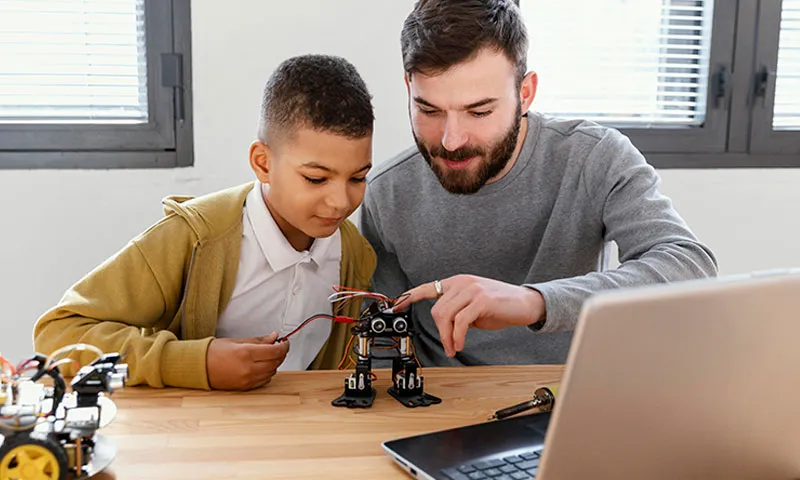
Robotics: High school students participating in robotics projects can use 3D printing to create custom parts for their robots.
They can design and manufacture custom components, improving the functionality and performance of their robotics projects.

Schedule: In programming and technology classes, students can design 3D models as part of their projects.
This allows them to apply their programming knowledge to create physical objects, combining skills in design, engineering, and computing.
These examples show how the 3D printing in schools They can enrich learning across a variety of subjects and educational levels, providing students with more hands-on, creative, and immersive learning experiences.
3D Printing and Inclusive Education
The 3D printing in schools It not only benefits students in general, but also plays a crucial role in inclusive education.
This technology has the potential to make learning more accessible and personalized for students with disabilities or special needs.
Here's how:
Accessibility
The 3D printing allows in schools create personalized educational materials that are tailored to the specific needs of each student.
For example, students with visual impairments can benefit greatly from 3D-printed tactile models.
Instead of relying solely on verbal descriptions or raised-relief images, they can touch and explore three-dimensional models of objects—such as relief maps, geometric shapes, or anatomical models—which enhances their understanding and learning experience.
One specific example is the creation of tactile maps. These 3D-printed maps allow students with visual impairments to explore the topography, geographic features, and points of interest in a region in a way that is understandable and accessible to them.

This not only makes it easier to learn geography, but also helps develop their spatial and orientation skills.
Adaptive Tools
The 3D printing in schools It can also produce adapted tools and assistive devices for students with special needs.

For example, students with motor disabilities may need specific tools for writing, drawing, or manipulating objects.
3D printing makes it possible to design and manufacture custom assistive devices, such as pencil holders, scissor adapters, or easy-grip utensils.

These tools can be adjusted to fit the student's exact measurements and needs, improving their ability to participate in school activities.
In another example, students with hearing impairments can benefit from 3D-printed models that depict sound vibrations or the functioning of the inner ear.
These models could help these students understand complex scientific concepts visually and through touch, compensating for their hearing loss with a multisensory learning experience.
Personalized Learning
The 3D printing for schools allows you to customize teaching materials, to adapt to the different learning styles and paces.
Teachers can design and create specific resources that address the individual needs of their students.
For example, in math, a student who struggles to understand fractions can benefit from 3D-printed models that represent fractions in a visual and tangible way, thereby making them easier to understand.

In addition, the ability to personalize learning also extends to student motivation and engagement.
3D-printed models can be used to create projects based on students' personal interests—from replicas of historical figures to models from their favorite movies—making learning more relevant and engaging for them.
Conclusion
The 3D printing for schools has the potential to transform inclusive education by providing accessible, personalized, and adaptive resources for all students, regardless of their abilities or special needs.
This technology enables educators to create more equitable and inclusive learning environments, where every student has the opportunity to reach their full potential.
Benefits of Hiring 3D Printing Services
The 3D printing in schools It can transform education by making it more interactive and accessible.
However, Purchasing 3D printing equipment and managing its maintenance can be costly and complicated.
This is where you can hire 3D printing services, such as the PCBWay's online 3D printing service, can offer a practical and efficient solution.
Here are the specific benefits of choosing these services.
Access to Advanced Technology
Order PCBWay's online 3D printing service It allows schools to access the latest technologies without having to invest in expensive equipment.
PCBWay offers a wide range of advanced 3D printers. This ensures that students and teachers always have access to the best technology available, which is essential for high-quality educational projects.
Cost Reduction
The initial investment in 3D printers, along with the costs of maintenance, materials, and upgrades, can be significant.
By using PCBWay's 3D printing service, schools can avoid these costs.
PCBWay offers competitive pricing for its services, which allows educational institutions to better manage their budgets and allocate resources to other important areas of education.
Flexibility and Scalability
If a school needs a large number of models for a specific project, PCBWay can handle large-volume orders with fast delivery times.
On the other hand, if the needs are less, Schools can request only what they need without having to worry about maintaining underutilized equipment.
Support and Technical Assistance
PCBWay not only offers 3D printing services, but also provides technical support and consulting.
Schools can benefit from the knowledge and experience of the PCBWay team to optimize their 3D printing projects.
Quality and Precision
PCBWay is known for the high quality and precision of its 3D prints. The models produced are detailed and durable, which is crucial for educational use.
PCBWay guarantees that the final products will meet the highest standards.
Access to Various Materials
Depending on the educational project, schools may need different types of materials, ranging from basic plastics to advanced resins.
PCBWay offers a wide selection of materials that can be tailored to the specific needs of each project, providing flexibility and options for educators.
Fast Delivery Time
In an educational setting, time is of the essence. PCBWay stands out for its fast turnaround times, ensuring that projects are not delayed.
Schools can plan their lessons and projects with the confidence that the 3D-printed models will arrive in time for use in the classroom.
Why Choose PCBWay
PCBWay's online 3D printing service offers schools an efficient and cost-effective solution for integrating 3D printing into the classroom.

From access to advanced technology and cost savings to technical support and flexibility, PCBWay provides all the resources needed to enrich students' learning.
By eliminating the need for costly investments and technical complications, schools can focus on what really matters: to provide a quality education that prepares students for the future.
GO TO PCBWAY'S ONLINE 3D PRINTING SITE
If you'd like to learn more about ordering 3D-printed parts using this service, I recommend reading the following articles:
Responses